How to Fix Severe 5.8G Interference? 10W 1.2G/3.3G/7.2G VTX Drone Video Transmission Alternative Solutions
In drone engineering projects, many system integrators and procurement engineers face a common tough issue: when operating with 5.8G drone video transmitter module, on-site Wi-Fi signals, wireless base stations and other drone devices create heavy RF interference. This causes pixelation, stuttering and packet loss on the FPV video feed. In extreme cases, the drone video link may drop out entirely, disrupting power line inspection, wildfire monitoring, security surveillance and other mission-critical operations.
The 5.8GHz band is widely adopted and low-cost, making it the first choice for many early drone video transmission projects. However, as industrial drone applications grow more complex, wireless devices in cities, factories and substations keep increasing, amplifying the weakness of overcrowded 5.8GHz spectrum. Field tests show that even high-power 5.8G video transmitters cannot guarantee stable links when surrounded by dense Wi-Fi signals.
Simply boosting transmit power cannot fundamentally solve 5.8G interference. A more reliable solution is to switch to alternative RF bands. 1.2G, 3.3G and 7.2G feature cleaner spectrum and unique diffraction & penetration characteristics. Paired with 10W high-power VTX video transmitter modules, you can build stable long-range drone video links. This article applies link budget theory to compare RF performance of 5.8G, 1.2G, 3.3G and 7.2G bands, analyzes 10W multi-band VTX selection for different scenarios, and delivers practical high-power drone video transmission alternatives for drone system integrators and engineering buyers.
1. Why Does 5.8G Drone Video Transmission Suffer from Heavy Interference?
The root cause of frequent interference on 5.8G is spectrum congestion. Household Wi-Fi, industrial wireless bridges, security radio links and consumer FPV drones all operate within 5.725GHz–5.850GHz. When drones fly over factory sites, substations or urban building clusters, abundant co-channel and adjacent-channel radio signals raise the noise floor of the video receiver and reduce signal-to-noise ratio.
From RF principles, 5.8G belongs to high-frequency band with short wavelength. High-frequency radio propagates mainly in line-of-sight and has weak diffraction. Once hills, buildings or trees block the path between drone and ground station, signal attenuation rises sharply. Combined with external interference, link margin drops rapidly and leads to video stutter or disconnection. Many engineering buyers get good lab test results for 5.8G VTX, but performance degrades severely in real-world complex electromagnetic environments. This is one of the most common pitfalls of 5.8G drone video links.
Some buyers try to mitigate interference by upgrading to higher-power 5.8G video transmitters. This is a misconception: external interference elevates the noise floor. Increasing transmit power only slightly improves link margin and cannot eliminate co-channel interference. When strong Wi-Fi or other interference exists, even high-power 5.8G VTX will still experience video packet loss. That is why more drone integrators are switching to alternative bands such as 1.2G, 3.3G and 7.2G, using 10W high-power video transmitters to build robust links.
Key pain points of 5.8G video transmission in industrial drone projects:
- Congested spectrum with massive Wi-Fi and radio devices, severe co-channel interference;
- Short wavelength, poor diffraction, fast signal attenuation under obstruction;
- Reduced receiver SNR in complex EM environments, causing stuttering and pixelated video;
- Higher transmit power alone cannot fully resolve external interference;
- Insufficient link margin for long-range inspection missions, prone to link dropout.
2. Link Budget Basics: Core Method to Evaluate Drone Video Link Stability
When selecting drone video transmitter modules and evaluating VTX performance, link budget is an essential tool for RF engineers. Link budget quantifies signal gains and losses across the whole wireless chain and calculates link margin. Larger link margin means stronger resistance to interference and attenuation, delivering better reliability in field deployments.
Link Budget Formula: Link Margin = Transmit Power + Tx Antenna Gain + Rx Antenna Gain − Free Space Path Loss − Feeder Loss − Environmental Attenuation − Receiver Sensitivity.
Transmit Power: RF output power of VTX; the 10W high-power drone video transmitter modules introduced in this article maintain fixed 10W output.
Free Space Path Loss: signal loss as radio waves travel through air. Higher frequency brings greater path loss at the same distance, which explains the natural advantage of low-frequency 1.2G for long-range applications.
Feeder Loss: signal loss in coaxial cables connecting VTX to antenna. High-frequency cables suffer noticeably higher loss than low-frequency counterparts.
Receiver Sensitivity: the minimum signal strength the receiver can decode correctly. Smaller negative dBm values represent better receiver sensitivity.
Link Margin: industrial best practice recommends keeping at least 12dB link margin on-site to handle obstructions and sudden electromagnetic interference. Low margin leads to unstable video transmission.
Path loss varies drastically across frequency bands. At identical flight distance, path loss order: 7.2G > 5.8G > 3.3G > 1.2G. Lower frequency has less path loss and retains more margin for long-range flight; higher frequency has larger path loss but cleaner spectrum and wider bandwidth. When selecting 10W VTX video transmitters, you need to apply link budget models and match bands to mission scenarios.
3. Band Parameter Comparison Table for 1.2G/3.3G/5.8G/7.2G (10W VTX)
The table below summarizes RF characteristics, propagation behavior, interference level and suitable applications of four common bands under 10W transmit power, helping procurement teams and system integrators quickly compare and select drone video transmitters.
| Frequency Band | 10W VTX Path Loss @10km | Diffraction & Penetration | Ambient Interference Level | Feeder Loss | Recommended Use Cases |
|---|---|---|---|---|---|
| 1.2G | Low | Strong, mild diffraction over hills & woods | Low, clean spectrum | Small | Long-range mountain power inspection, long-distance surveillance |
| 3.3G | Medium | Medium, works with light obstructions | Low, few Wi-Fi devices | Medium | Factory inspection, suburban security, balanced range & bandwidth |
| 5.8G | High | Weak, link drops easily under obstruction | Very high, dense Wi-Fi interference | Relatively high | Short-range open areas with low interference |
| 7.2G | Very high | Weak, almost no diffraction capability | Very low, clean spectrum | Large | Open flat land, obstruction-free factory high-definition video transmission |
The table clearly shows that when 5.8G suffers heavy on-site interference, 1.2G, 3.3G and 7.2G are viable alternatives. However, their performance differs significantly, so you cannot pick randomly. Select 10W VTX video transmitters based on operating environment, flight range and obstructions.
4. Analysis of 10W Multi-Band VTX Video Transmitter Solutions
4.1 10W 1.2G VTX: Top Alternative for Long-Range & Obstructed Scenarios
The 1.2G band is the preferred solution to resolve 5.8G interference for mountain long-range power inspection. Low-frequency radio waves feature longer wavelength, minimal free space loss and excellent diffraction. The drone can maintain basic communication even when hills or trees block the path. Few consumer Wi-Fi devices occupy 1.2G, delivering a clean RF environment without the massive co-channel interference seen at 5.8G.
When paired with a 10W high-power VTX video transmitter, link budget remains sufficient for long-range missions. Field tests on mountain power inspection projects demonstrate notable improvements in anti-interference performance and transmission range compared with 5.8G drone video transmitters of equal power. Ideal for high-voltage power line patrol, wildfire surveillance and other long-range missions with terrain blockages.
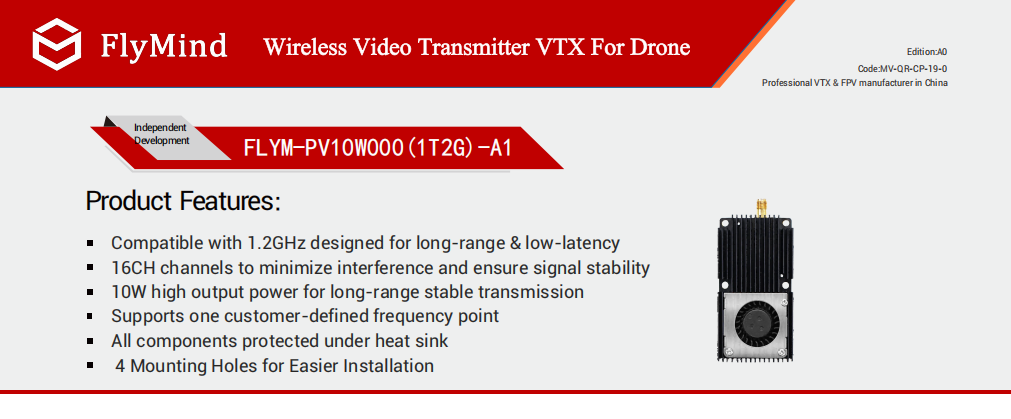
Notes for 10W 1.2G VTX: low-frequency antennas are physically larger. You need to assess available mounting space if your drone payload is limited. Bandwidth is narrower than high-frequency bands, suitable for standard-definition analog video transmission that meets inspection requirements.
4.2 10W 3.3G VTX: Balanced Range & Bandwidth, Ideal for Industrial Factory Sites
The 3.3G band sits between 1.2G and 5.8G in performance. Few Wi-Fi devices operate here, so it avoids heavy 5.8G Wi-Fi interference. Its diffraction capability surpasses 5.8G and 7.2G, usable in factory and industrial park environments with minor building obstructions.
The 10W 3.3G VTX video transmitter delivers balanced link budget, balancing transmission distance and video bandwidth. It works well for factory security patrol and industrial park drone monitoring. Many integrators test 3.3G VTX first for suburban projects where 5.8G interference cannot be resolved.
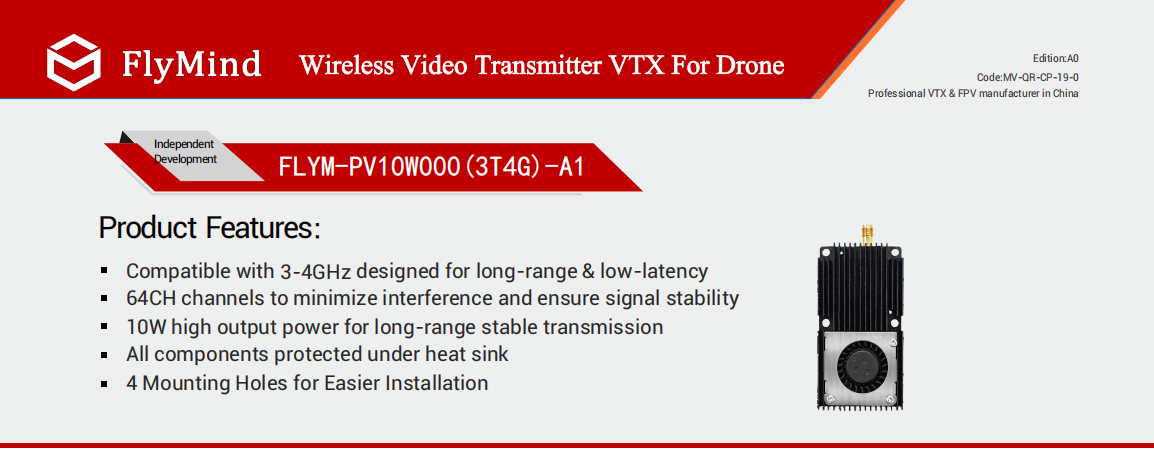
4.3 10W 7.2G VTX: Clean Spectrum High-Definition Video for Line-of-Sight Open Areas
7.2G has a virtually interference-free spectrum with almost no consumer Wi-Fi devices, fully bypassing 5.8G Wi-Fi interference. This high-frequency band supports wider bandwidth for higher-definition video feeds. However, 7.2G radio waves have short wavelength and poor diffraction, plus high path loss. Signal attenuates rapidly if hills or buildings block the path.
10W 7.2G VTX fits open plains and large open-air factories with clear line-of-sight between drone and ground receiver. Do not select 7.2G as a 5.8G replacement if your mission has heavy obstructions. Complete link budget calculation and reserve sufficient margin before selection.

5. Engineering Procurement Checklist: Switching from 5.8G to 10W Multi-Band VTX
If your current project suffers severe 5.8G drone video interference and you plan to upgrade to 1.2G/3.3G/7.2G 10W VTX modules, do not only evaluate transmit power. Assess multiple factors to avoid field failures. Based on numerous deployed projects, we compiled this procurement checklist.
- Link Budget Calculation: estimate flight distance and obstructions to compute link margin; reserve ≥12dB margin for field deployment;
- Receiver Sensitivity: receiver sensitivity directly determines link performance; prefer matched high-sensitivity receiver modules;
- Antenna Matching: antennas cannot be reused across bands. 1.2G, 3.3G and 7.2G each require dedicated antennas; antenna gain impacts overall link performance;
- Feeder Selection: high-frequency 7.2G coaxial cables have high loss; keep cables as short as possible to reduce signal attenuation;
- Power Consumption & Weight: drone payload is limited; check VTX module weight and power draw to match drone power supply;
- Field Testing: test samples on your actual project site instead of relying purely on lab data to verify real-world anti-interference performance;
- Bulk Delivery: for volume orders, confirm lead time and technical support to meet project milestones.
Many buyers overlook losses introduced by antennas and feeders. Even with 10W high-power drone video transmitters, mismatched antennas or long cables will eat up RF gain and reduce link margin, resulting in unstable video. Antennas and coaxial cables are integral parts of the video link and must be included in link budget calculations.
6. Product Recommendation: 10W Multi-Band VTX Drone Video Transmitter Modules
To solve heavy 5.8G interference in industrial drone projects, we independently develop and manufacture 10W 1.2G/3.3G/7.2G VTX high-power video transmitters as stable alternatives to 5.8G video links. The complete drone video solution includes VTX transmitter, matched receiver and band-matched antennas, compatible with power inspection drones, security surveillance UAVs, wildfire monitoring drones and other industrial drone platforms.
This series of 10W video transmitters uses analog FPV video architecture with stable RF performance and customizable tuning to optimize links for your project environment. All units undergo high-low temperature, vibration and RF burn-in testing to withstand harsh outdoor conditions. We support sample testing and bulk orders, and provide technical support for drone integrators including link budget calculation and on-site commissioning guidance.
Target customers: industrial drone system integrators, power inspection contractors, security solution providers and drone equipment purchasers. If your project suffers Wi-Fi interference, stuttering and packet loss on 5.8G video feeds, contact us for sample testing and custom drone video link solutions tailored to your operational environment.
7. Frequently Asked Questions
Q1: With the same 10W power output, why is 1.2G far more resistant to interference than 5.8G?
A1: The difference comes from spectrum environment and RF propagation characteristics. The 5.8G band is widely used by Wi-Fi, wireless bridges and consumer drones in cities, factories and residential areas, creating a high noise floor with unavoidable co-channel and adjacent-channel interference. The 1.2G band has very few civilian devices and clean spectrum. Meanwhile, longer wavelength delivers superior diffraction over 5.8G, so signals attenuate slower under obstructions. Combined with 10W high output, it provides ample link margin and better stability than 5.8G VTX at equal power.
Q2: When switching to 1.2G/3.3G/7.2G VTX, do I need to replace antennas and feeders?
A2: Yes, dedicated antenna and feeder sets are required; they cannot be reused across bands. Antenna gain, VSWR and frequency response are band-specific. Using a 5.8G antenna for 1.2G, 3.3G or 7.2G will cause severe standing wave and signal loss, negating the benefit of 10W high power. 7.2G also requires low-loss high-frequency cables with minimal length. Our 10W multi-band VTX kits come with matched antennas and feeders ready for deployment.
Q3: Compared with standard 3W/5W video transmitters, what are the anti-interference and long-range advantages of 10W multi-band VTX?
A3: Low-power video transmitters have very small link margin. Minor interference or light obstructions trigger packet loss and stutter. 10W high-power output raises the link budget threshold and reserves robust interference tolerance. In mountainous terrain, high-voltage substation EM noise and dense urban interference scenarios, it suppresses background noise and delivers stable video. Operational range can increase by 30%-80%, supporting long-duration high-reliability industrial inspection missions.
Q4: The 7.2G band has the cleanest spectrum. Why is it not recommended for all projects?
A4: The main limitation of 7.2G is poor propagation and diffraction. Its short wavelength barely diffracts around hills, buildings or trees, and path loss plus feeder loss are much higher than 1.2G and 3.3G. It works only for line-of-sight open sites. If terrain or buildings block the path, even 10W power will suffer rapid signal decay and link dropout. Therefore, 7.2G is only recommended for flat open factory sites and plains; choose 1.2G or 3.3G for obstructed complex environments.
Q5: 1.2G VTX has narrower bandwidth than 5.8G. Will it reduce inspection video clarity?
A5: It fully meets industrial inspection requirements. Power line patrol and security monitoring prioritize stable, uninterrupted video over ultra-high resolution. The 10W 1.2G analog video transmitter delivers clear, natural color footage to identify line damage, equipment defects and geological hazards accurately. Compared with 5.8G’s frequent stuttering and pixelation, smooth stable video from 1.2G is better suited for industrial missions and passes project acceptance criteria.
Q6: For bulk orders of 10W multi-band VTX, do you support custom frequency and parameter tuning?
A6: Yes, full customization service is available. We can customize frequency channels, transmit parameters and power modes according to regional spectrum regulations, flight range and electromagnetic environment. Volume projects get dedicated technical liaison, link budget calculation and on-site commissioning support. OEM and ODM customization are supported to fit various drone airframe designs and satisfy mass deployment requirements for system integrators.
8. Conclusion
5.8G Wi-Fi interference has become a major roadblock for many industrial drone deployments. Simply cranking up 5.8G transmit power cannot eliminate interference. Switching to low-interference frequency bands, deploying 10W high-power drone video transmitters and designing the system with link budget calculations forms a reliable engineering solution. 1.2G, 3.3G and 7.2G each have suitable scenarios: pick 1.2G for long-range mountain inspection, 3.3G for medium-range factory sites, and 7.2G for high-definition open-area missions.
When engineering teams select drone video transmitters, do not rely only on datasheet specs. Calculate link budget based on real operating conditions and validate performance with sample field tests. Our 10W multi-band VTX modules cover 1.2G / 3.3G / 7.2G bands and provide robust alternatives for industrial drone projects. Welcome industry partners to inquire about sample testing and bulk procurement.
【Business & Contact】
We specialize in R&D and manufacturing of high-power drone video transmitters, including 10W multi-band VTX (1.2G/3.3G/7.2G), thermal FPV cameras and other drone accessories. We provide sample testing, bulk supply and technical support for global industrial drone integrators and engineering companies. Our team can assist with link budget evaluation and on-site commissioning guidance. Feel free to contact us to get product datasheets and sample test proposals.
Tel: +86 19974915206 (WhatsApp)
Email: market@flymind.com.cn


