What to Know About OEM Customization for Drone Video‑Transmitters? Procurement & Custom Workflow Reference for System Integrators
In industrial drone integration, project bidding and mass‑production deployment, standardized industrial drone VTX video‑transmission modules often fail to meet personalized requirements for airframe structure, operating scenarios and project compliance. More and more industrial system integrators and drone manufacturers opt for drone video‑transmitter OEM customization services. Customizable items include frequency bands, transmit power, hardware interfaces, firmware and appearance to fit segmented applications such as power‑line inspection, urban security, emergency search‑and‑rescue and plant mapping.
Nevertheless, most purchasers and R&D engineers lack hands‑on customization experience. Common pain points include ambiguous requirements, mismatched customized parameters, unqualified prototype acceptance, unstable mass‑production batches and compliance issues, resulting in project rework, delivery delays and cost overruns.
Drawing on mass‑production customization experience with industrial‑grade 5.8GHz analog video transmitters and 7.2GHz high‑frequency video transmitters, this article explains core considerations for drone video‑transmitter OEM customization, end‑to‑end procurement workflows, customizable parameter specifications and common pitfalls. It delivers practical, ready‑to‑use guidance for B‑end integrators carrying out bulk customized procurement.

I. Core Benefits of Industrial Drone VTX OEM Customization
Different from consumer‑grade FPV video transmitters, industrial drone video‑transmitter OEM customization focuses on scenario adaptation, airframe compatibility, project compliance and mass‑production stability. It serves as a key enabler for differentiated industrial drone solutions, bidding advantages and high‑end model iteration. Four major benefits are listed below:
1. Scenario‑Oriented Adaptation: Custom frequency bands, power levels and thermal‑dissipation schemes for environments with heavy urban electromagnetic interference, mountain‑area obstructions and long‑range operations, solving common issues such as link stuttering, static noise and signal attenuation;
2. High Airframe Compatibility: Custom‑tuned interface dimensions, mounting specifications and dual‑power grounding solutions according to drone airframe layout, power supply system and mounting holes to lower system‑integration difficulty;
3. Controllable Project Compliance: Calibrable transmit power and radio‑frequency parameters to satisfy industrial‑project bidding compliance requirements and mitigate compliance risks;
4. Brand Differentiation: Support for laser‑engraved LOGO, privatized firmware and dedicated parameter tuning, helping integrators launch self‑branded industrial drone products.
II. Key Customizable Parameters for Drone VTX OEM (Procurement Checklist)
Many customization projects fail due to vague requirements without clear definition of customizable boundaries. Industrial VTX customization cannot modify hardware arbitrarily; all adjustments must be based on underlying hardware capabilities. Below are high‑frequency customization items for industrial projects, covering 5.8GHz analog video transmitters and 7.2GHz high‑frequency video transmitters.
| Customization Item | Customizable Content | Applicable Scenarios | Custom Priority |
|---|---|---|---|
| Frequency Bands & Channels | Custom 5.8GHz and alternative frequency bands, dedicated private channel locking, 80CH / 64CH channel‑planning optimization | Urban heavy‑interference environments, multi‑drone swarm operations, high‑end customized airframes | Highest |
| Transmit Power Levels | Adjustable 1W/3W/5W/7W/10W power gears, fixed‑power output, PIT low‑power‑mode parameter tuning | Compliance‑restricted deployments, long‑range inspection, lightweight long‑endurance airframes | Highest |
| Hardware Interfaces & Mechanical Structure | SMA antenna port matching, JST 8‑pin pin‑out definition, dual‑input power‑grounding scheme, mounting‑hole dimension adjustment, overall module dimension fine‑tuning | Compact industrial drones, custom‑built airframes, special power‑supply systems | High |
| Firmware Feature Customization | LED indicator logic optimization, default power‑band parameter customization, SA protocol customization, OSD display adaptation, audio‑transmission switch tuning | Mass‑produced standard models, one‑click operation scenarios, simplified maintenance requirements | Medium‑High |
| Appearance & Packaging | Module LOGO marking, custom model number, customized packaging and label parameters | Self‑branded complete drones, OEM resale, project delivery | Medium |
| Thermal‑Dissipation Tuning | Fan on‑off logic, full‑load temperature‑control optimization, long‑duration non‑derating parameter calibration | All‑weather field deployment, high‑temperature environments, long‑hour full‑load inspection missions | High |
III. Standard OEM Customization Workflow for Industrial Drone VTX (For System Integrators)
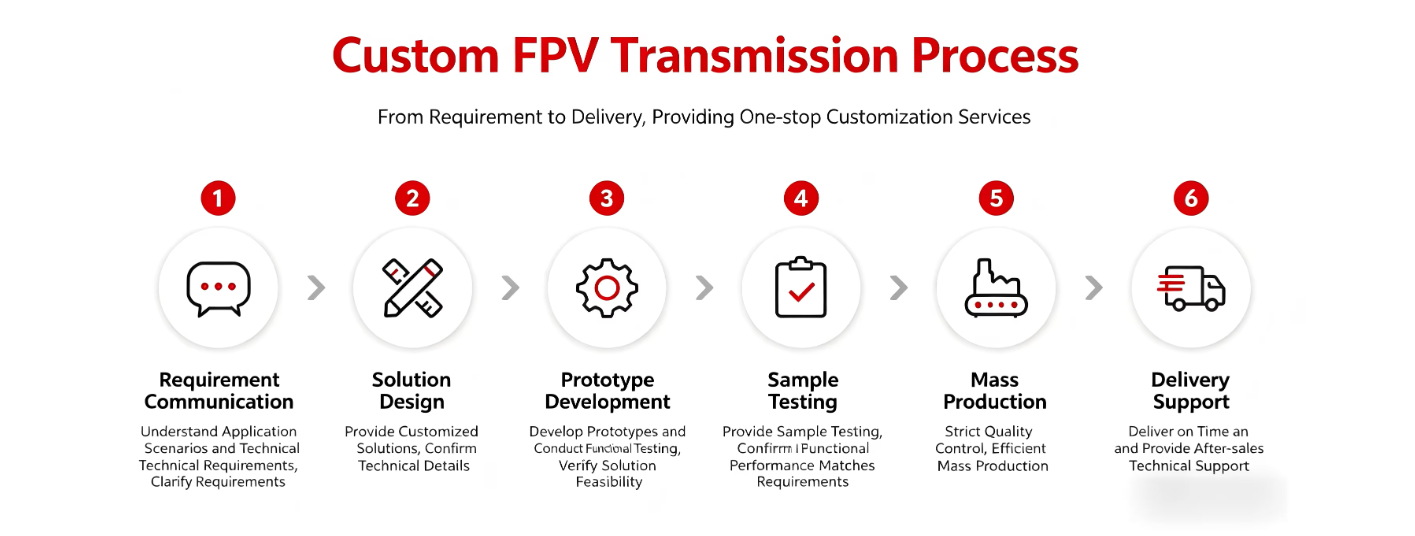
A standardized workflow guarantees mass‑production stability and avoids rework risks. Based on B‑end bulk‑procurement requirements, we define a six‑step workflow: Requirement Gathering → Solution Confirmation → Prototype Sampling → Test & Acceptance → Mass Production → After‑sales Handover, applicable to all industrial VTX customization projects.
Step 1: Clarify and Submit Project Requirements (Critical Pre‑Customization Phase)
Procurement and R&D teams shall clarify all requirements in advance and avoid vague descriptions. Key points to confirm: operating scenarios, target frequency band (5.8GHz general / 6‑7GHz anti‑interference), power levels, supply voltage, pin‑out definition, private‑channel requirements, channel quantity, thermal requirements, branding requirements, order volume and delivery schedule. Project compliance constraints must be clarified to prevent non‑compliance with bidding and industry certification standards after customization.
Step 2: Vendor Technical Evaluation & Quotation
The vendor conducts technical feasibility assessment to verify hardware compatibility, modification complexity, sampling cost and lead time, and delivers a formal custom solution, detailed quotation and delivery timeline. Key review items: scenario matching of customized parameters, support for VTX channel planning, long‑term full‑load stability and scope of technical after‑sales support.
Step 3: Prototype Sampling & Engineering Tuning
After solution confirmation, 3‑10 engineering prototypes are produced with hardware revision, firmware debugging and parameter calibration. Key prototype tests include frequency accuracy, transmit‑power stability, dual‑power‑grounding reliability, low‑latency performance, high‑temperature thermal performance and multi‑unit anti‑interference capability for airframe integration validation.
Step 4: Airframe‑Integrated Testing & Acceptance Sign‑off
Integrators install prototypes onto drones and run full‑range tests including indoor bench tests, short‑range outdoor flights, long‑range flights and obstruction scenarios. Watch for link stuttering, static noise, signal fluctuation, thermal power derating, interface incompatibility and excessive latency. Upon passing all tests, both parties sign acceptance criteria and lock final customized parameters as the sole reference for mass production.
Step 5: Mass Production & Quality Control
Mass production is performed against locked parameters. Industrial customization requires strict control over RF‑parameter consistency, thermal‑module matching and soldering standards to guarantee uniform performance across batches and eliminate batch‑induced airframe failures. Production‑test reports and parameter records shall be retained for traceable after‑sales support.
Step 6: Project Handover & Ongoing Technical Support
Upon bulk delivery, the vendor provides customized‑parameter sheets, user manuals, tuning guides and compliance documents. Technical handover covers subsequent firmware updates, fine‑tuning and fault diagnosis to support long‑term project iteration.
IV. Hidden Pitfalls of Drone VTX OEM Customization (B‑end Procurement Warnings)
Many custom projects fail due to overlooked details. Summarized from real‑world industrial deployments, these 8 typical pitfalls help integrators reduce project risks:
1. Over‑specifying high‑frequency bands blindly: For non‑urban low‑interference scenarios, 6‑7GHz high‑frequency customization is unnecessary and increases procurement cost and accessory‑matching difficulty. Standard 5.8GHz analog video transmitters with 80CH channel planning satisfy most industrial use‑cases;
2. Parameter‑only modification without airframe matching: Adjusting power or frequency bands without matching drone power supply, thermal design and antenna gain causes unstable links and thermal‑induced power derating after customization;
3. Unwritten acceptance criteria: Verbal requirement agreements without formal documented acceptance standards leave no recourse when mass‑produced units deviate from expected performance;
4. Ignoring compliance requirements: High‑power customization without RF‑parameter calibration may result in failed bidding audits and blocked project deployment;
5. Inadequate channel‑planning consideration: Multi‑drone swarm deployments without custom private channels and channel‑isolation design lead to severe co‑channel interference after mass deployment;
6. Vague interface definitions: Specifying connector types without clear pin‑out, power‑supply logic and grounding rules triggers soldering errors and short‑circuit risks during integration;
7. Skipping field testing before mass production: Relying purely on lab‑bench validation without real‑world outdoor testing results in excessive latency, signal attenuation and insufficient anti‑interference performance in actual missions;
8. Neglecting post‑customization iteration capability: Vendors without independent R&D capacity cannot deliver firmware upgrades or parameter fine‑tuning after delivery, leaving no room for future project iteration.
V. OEM Customization vs Standard Off‑the‑Shelf VTX: Procurement Comparison Table
Many purchasers struggle to decide whether customization is required. Compare against your project requirements:
| Comparison Item | Standard Off‑the‑Shelf VTX | OEM‑Customized VTX | Suitable Project Types |
|---|---|---|---|
| Parameter Adaptability | General‑purpose parameters for common scenarios, no personalized adjustments | Custom frequency bands, power levels, interfaces and firmware for full project alignment | Custom fit: high‑end airframes, dedicated projects, bidding differentiation requirements |
| Delivery Lead Time | Immediate stock availability, ideal for urgent short‑term projects | Prototype tuning plus mass‑production cycle; better for volume‑oriented projects | Off‑the‑shelf preferred: prototype testing, small‑batch trials, short‑term missions |
| Cost Profile | Low unit price without custom‑engineering fees, high cost‑efficiency | Upfront sampling and modification costs; unit cost becomes competitive at large volumes | Custom preferred: long‑term mass production, branded hardware, high‑end government‑enterprise projects |
| Operational Stability | General‑purpose performance; prone to interference and signal attenuation under complex field conditions | Targeted scenario‑specific tuning for enhanced stability during long‑duration field operations | Mandatory for complex environments: urban security, multi‑drone swarms, long‑range inspection |
VI. Procurement Checklist for Drone VTX OEM Customization
Use this standardized checklist during requirement communication, prototype acceptance and pre‑mass‑production review to reduce project risks:
☐ Define operating scenarios, interference levels and transmission range to lock frequency‑band and power‑customization plans
☐ Confirm hardware interfaces, pin‑out definitions, supply voltage and mounting‑hole dimensions to avoid integration incompatibility
☐ Define private channels and complete VTX channel planning for multi‑drone deployments to eliminate co‑channel interference
☐ Validate prototypes in both lab‑bench and real‑world outdoor tests to verify latency, thermal performance and anti‑interference capability
☐ Formalize customized parameters, acceptance criteria, warranty terms and post‑delivery iteration services in written documents
☐ Confirm batch quality‑control standards before mass‑production to guarantee consistent product performance
VII. Frequently Asked Questions (FAQ)
What is the MOQ for drone VTX OEM customization? Is large‑volume ordering mandatory?
Industrial VTX OEM customization includes prototype sampling and mass‑production phases. Small‑quantity prototype sampling is available. Mass‑production minimum order quantity depends on modification scope. Simple customizations such as LOGO marking or label‑only changes carry low MOQ requirements. Hardware revisions and deep‑level RF‑firmware rewriting require higher minimum volumes. Confirm sampling fees and MOQ thresholds during early‑stage communication.
Can transmit power be modified in 5.8GHz analog‑VTX OEM customization to boost transmission range?
Transmit‑power gears can be tuned via customization. However, effective transmission range depends not only on power output, but also on antenna selection, onboard power‑supply quality, thermal conditions and real‑world electromagnetic environment.
Can OEM‑customized industrial drone VTX modules receive future firmware upgrades?
Vendors with in‑house R&D capability support firmware iteration and parameter fine‑tuning for customized versions. For simple label‑only modifications without underlying hardware changes, firmware capacity matches standard off‑the‑shelf products. Confirm firmware‑update support and technical documentation availability during procurement to avoid roadblocks for later‑stage project iteration.
Can OEM customization implement private custom channels and VTX channel‑planning for multi‑drone swarm deployments?
Yes. During OEM development, dedicated private channels and optimized 80CH channel tables can be implemented for multi‑drone swarm scenarios to achieve channel isolation and mitigate co‑channel interference. Provide expected drone‑count and field‑interference profiles upfront to obtain application‑optimized channel schemes.
How large is the cost gap between OEM‑customized and off‑the‑shelf VTX? When should customization be avoided?
Simple cosmetic‑label customization adds limited extra cost. Hardware revisions and deep firmware development incur sampling and modification fees. For routine‑inspection standard‑condition deployments, standard 5.8GHz analog‑VTX stock units are sufficient and deep customization is unnecessary. OEM customization delivers higher ROI only when off‑the‑shelf modules fail to satisfy interface, thermal, compliance or project‑differentiation requirements.
VIII. Summary
Drone video‑transmitter OEM customization is a powerful tool for differentiated industrial‑drone deployment, mass‑volume manufacturing and high‑end project bidding. It is far more than simple parameter tweaks; it represents comprehensive adaptation tuned for operating scenarios, airframe mechanical layout and compliance constraints. Integrators should avoid over‑customization across all dimensions. Select only needed custom items for frequency bands, power, interfaces and firmware. Follow standardized workflows, complete thorough prototype validation and lock down formal parameters. This approach effectively prevents rework, instability and compliance risks and delivers highly‑adaptable, reliable low‑latency industrial‑drone video‑transmission solutions.


