10W Multi-Band VTX Comparison: Choose 1.2G,2.4G,3.3G,5.8G,7.2G Drone Video Link
10W Multi-Band VTX Comparison: How to Choose 1.2G, 2.4G, 3.3G, 5.8G, 7.2G Drone Video Link Solutions
Quick Navigation
1. Introduction2. VTX Band Basic Principles3. Parameter Comparison Table4. Band Advantages, Disadvantages & Use Cases5. B2B Procurement Selection Criteria6. Integration Considerations7. FlyMind Customization Capabilities8. FAQ9. SummaryWhy Industrial Drone Projects Are Widely Adopting 10W High-Power VTX
In industrial drone applications such as power line inspection, forest fire prevention, emergency rescue, mine surveying and urban security, many project managers encounter the same pain point: once the flight range extends, the video feed suffers from snow, stuttering or signal dropout. Low-power standard VTX units lack stability in complex terrain and obstructed environments, which may lead to signal loss and even drone crashes during project acceptance.
When B2B buyers select components, increasing transmit power is often the first consideration. 10W high-power analog VTX has become a popular option for industrial drone integration projects, balancing transmission range, cost and integration difficulty. However, power is only one metric. Band selection often impacts video link stability more significantly than transmit power.
Even at the same 10W transmit power, 1.2G, 2.4G, 3.3G, 5.8G, 7.2G bands differ drastically in propagation characteristics, interference resistance, transmission distance, antenna size and spectrum environment. Many system integrators run into pitfalls by only focusing on 10W power while ignoring band compatibility: deploying 2.4G in urban areas leads to heavy WiFi interference; selecting 5.8G for long-range mountain projects causes video dropout with minimal obstructions.
This guide targets industrial drone B2B buyers and system integrators. It compares the pros and cons of 5 mainstream VTX bands at 10W power, draws on real-world project cases to help you select the right band for different scenarios, and covers critical points for 10W high-power VTX integration, thermal design, antenna matching and regulatory compliance to avoid common selection and deployment pitfalls.
FlyMind supplies 10W multi-band analog VTX modules with band customization, antenna matching tuning and OEM/ODM customization services, suitable for industrial inspection, emergency response, swarm FPV drone and other project requirements.
Drone VTX Band Fundamentals: 1.2G / 2.4G / 3.3G / 5.8G / 7.2G Band Properties
Radio signal propagation follows a core rule: Lower frequency equals longer wavelength and stronger diffraction, enabling signals to bend around hills, trees and buildings. Higher frequency has shorter wavelength, travels mainly in line-of-sight, with poor diffraction but cleaner spectrum and better resistance to multipath interference.
- Low band (1.2G): Long wavelength, excellent diffraction and low free-space loss over long distances. Drawbacks include larger antenna size and susceptibility to interference from legacy radio equipment and radar systems.
- Mid bands (2.4G, 3.3G): Balanced performance. 2.4G is widely used by consumer WiFi and Bluetooth devices; 3.3G is an industrial dedicated band with far fewer civilian interference sources.
- High bands (5.8G, 7.2G): Short wavelength, compact antennas and abundant spectrum resources. 5.8G is the classic FPV band but suffers severe WiFi interference in urban settings. 7.2G features a clean spectrum for dense urban RF environments, yet signal attenuation becomes dramatic with obstructions.
Important Note: All comparisons are conducted at a fixed transmit power of 10W. With power unchanged, the frequency band dictates signal propagation performance.
Advantages, Disadvantages & Application Cases for 5 Bands of 10W VTX
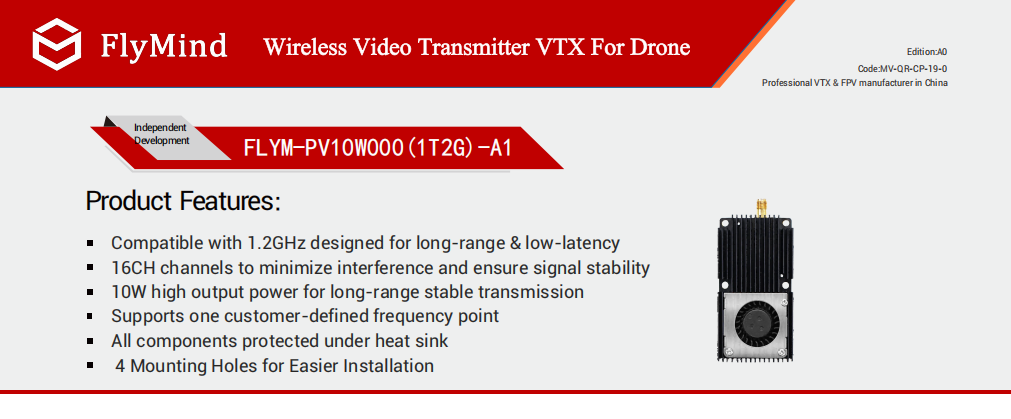
4.1 1.2GHz 10W VTX:Long-Range Inspection First Choice, Strong Obstacle Bending Capability
Advantages
- Long wavelength delivers the best diffraction and penetration among the five bands. Signals remain stable with hilly terrain and tree cover, making it the top pick for long-distance power line inspection and forest fire prevention.
- Low free-space propagation loss at 10W power. With identical antenna gain, it achieves significantly longer communication range compared to higher frequency bands.
- Weak multipath reflection, minimizing video flickering caused by signal reflection in mountainous field environments.
Disadvantages
- Large antenna size, creating mounting constraints for compact industrial drones.
- Strict spectrum regulations in some regions; verify local radio rules before deployment.
- Vulnerable to interference from radar and legacy wireless communication equipment. Use caution near radar stations.
Recommended Use Cases: Long-distance power line patrol, forest fire monitoring, mountain & river surveying, long-range wilderness emergency search & rescue; large-radius operations with open terrain plus vegetation or hillside obstructions.
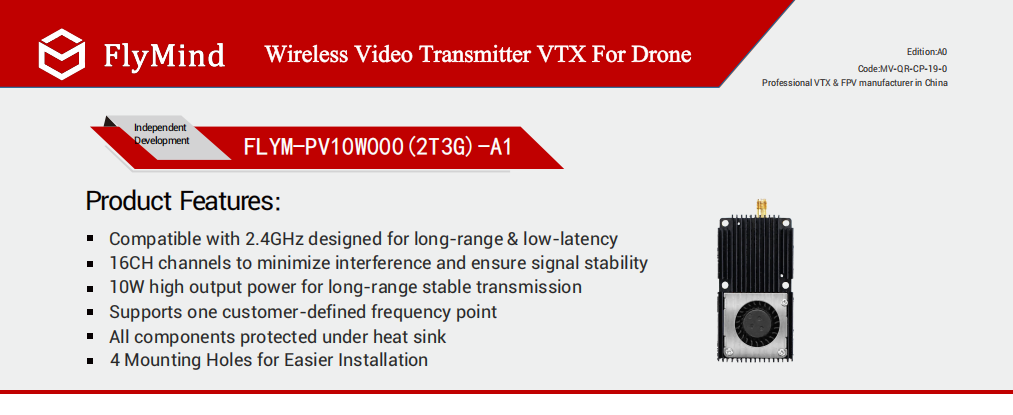
4.2 2.4GHz 10W VTX:High Compatibility, High Risk of WiFi Interference
Advantages
- Globally mature universal band with abundant off-the-shelf antennas and receivers, low procurement cost and broad familiarity among integration engineers.
- Decent diffraction performance, balancing range and antenna footprint for stable operation in open wilderness sites.
Disadvantages
The biggest limitation: 2.4G is shared by WiFi, Bluetooth and radio remote controllers. In towns, factories and residential zones, numerous 2.4G wireless devices operate concurrently, triggering severe signal interference, video snow, frame skipping and even complete video link loss.
Recommended Use Cases: Open rural areas far from urban WiFi signals; farmland mapping, grassland inspection. Not recommended for cities, factory dormitories or other WiFi-dense environments.
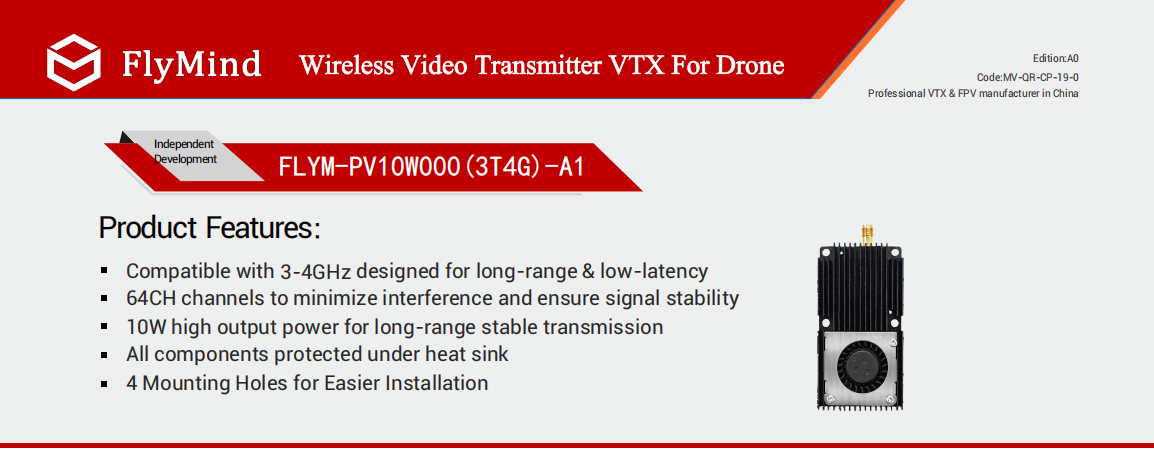
4.3 3.3GHz 10W VTX: Industrial Dedicated Band, Balanced Range & Interference Resistance
Advantages
3.3GHz is reserved for industrial private networks. Consumer WiFi and Bluetooth devices do not occupy this spectrum, resulting in very few interference sources. Its diffraction capability sits between 2.4G and 5.8G, tolerating partial obstructions while maintaining a moderately sized antenna. It is a reliable compromise solution for mines and large factories with complex electromagnetic environments.
Disadvantages
Fewer receiver and antenna options compared to 2.4G / 5.8G, leading to higher procurement cost. Maximum long-range performance is inferior to 1.2G.
Recommended Use Cases: Large factory inspection, mine exploration, port security, industrial park emergency drones; semi-obstructed industrial sites requiring both interference immunity and moderate transmission distance.
4.4 5.8GHz 10W VTX:Classic FPV Band for Short-Range Urban Operations

Advantages
The most widely adopted band in the FPV industry. Compact antennas, mature receiver solutions, low purchasing cost and abundant integration case history. Delivers low video latency in unobstructed short-range scenarios.
Disadvantages
Poor diffraction. Signal attenuates rapidly with walls or tree cover. Urban areas are crowded with 5.8G WiFi routers and cameras, creating heavy spectrum congestion and interference. Not suitable for long-range projects.
Recommended Use Cases: Indoor factory inspection, short-range urban emergency response, FPV racing drones; short flight range, line-of-sight and no heavy obstructions.
4.5 7.2GHz 10W VTX: Clean High-Frequency Spectrum, Anti-Interference Solution for Dense Cities

Advantages
7.2GHz sits within a relatively clean spectrum segment rarely used by consumer wireless devices. Almost no WiFi interference in cities. High-frequency signals outperform 5.8G against multipath reflection in high-rise urban environments, effectively avoiding the widespread WiFi interference plaguing 5.8G. The smallest antenna size, easy to mount on compact drones.
Disadvantages
High-frequency signals attenuate quickly and diffract poorly. Signal drops sharply when blocked by buildings or hills. It has the shortest maximum transmission distance among the five bands at identical power.
Recommended Use Cases: Urban security inspection, city emergency rescue, building exterior wall inspection; high-rise dense areas flooded with WiFi signals, with line-of-sight flight paths.
Core B2B Procurement Selection Criteria (Buyer Reference)
Many buyers only review power rating and price when evaluating VTX datasheets, which often leads to wrong band selection. We summarize 4 priority assessment factors for B2B procurement, evaluate in sequence:
- Project Operating Environment (Top Priority)
- Maximum Flight Radius & Obstacle Conditions
- Local Radio Spectrum Compliance Rules
- Drone Airframe Mounting Space
Mountain / wooded long-range → Prefer 1.2G; Mine & industrial plant →3.3G; Open wilderness →2.4G; Urban high-rise line-of-sight →7.2G; Short-range open FPV →5.8G.
Longer flight range and heavier obstructions favor lower frequency bands. For short-range line-of-sight flights with heavy urban interference, select clean high-frequency bands.
Different regions impose varying access requirements for transmit equipment operating on 1.2G, 3.3G and 7.2G bands. Confirm local radio regulations before project deployment to prevent equipment acceptance failures.
Low-frequency antennas are large. For lightweight compact drones, prioritize 5.8G /7.2G compact antenna solutions.
Supplementary note: Do not rely purely on higher transmit power to compensate for inherent band weaknesses. Even boosting 5.8G power to 10W for urban projects, WiFi interference remains. For mountain long-range projects, 7.2G at 10W will still lose signal rapidly behind hills.
10W VTX Drone Integration Guidelines: Compliance, Thermal Management, Antennas & Power Supply
10W is classified as high-power analog VTX. Compared with 1W and 2.5W low-power modules, integration design contains many details that frequently trip up system integrators.
- Thermal Design
- Critical Antenna Matching
- Stable Power Supply
- Spectrum Regulatory Compliance
- EMC Compatibility with Onboard Devices
10W transmit operation generates significant heat. Bare installation inside the cramped drone fuselage triggers power derating and unstable signal; prolonged high temperature shortens module service life. Reserve thermal space during integration, fit heat sinks and design airflow channels. FlyMind 10W VTX ships with optimized thermal structures, and custom thermal solutions are available matching customer enclosure designs.
Identical VTX hardware delivers drastically different performance with mismatched antenna gain and VSWR. Antennas are band-specific and cannot be cross-band reused. For example, a 1.2G antenna cannot work for 7.2G. We can supply matched antennas for each band and perform VSWR tuning to guarantee overall radio performance.
High-power VTX draws larger instantaneous current. Excessive voltage drop from the drone power supply destabilizes VTX output. Calculate peak current and select proper wiring and voltage regulators when designing power circuits.
Commercial deployment of high-power radio transmitters must comply with local radio administration laws. B2B buyers should confirm band licensing requirements before project bidding and acceptance.
Drones carry GPS, video transmitters, radio control and thermal cameras operating simultaneously. High-power VTX may introduce electromagnetic interference to other onboard electronics. Conduct EMC testing during system debugging. FlyMind supports customers with full-system electromagnetic compatibility tuning.
FlyMind Custom VTX Service Capabilities
FlyMind specializes in R&D and manufacturing industrial analog drone video transmitters. Our mature mass-production 10W multi-band VTX product line covers 1.2G, 2.4G, 3.3G, 5.8G and 7.2G.
- ✅ OEM / ODM customization available: Modify enclosure, interfaces, power parameters and tuning firmware;
- ✅ Antenna selection support, VSWR tuning and full system integration technical support;
- ✅ Bulk order supply, sample testing support, complete technical manuals and test reports;
- ✅ Recommend optimal band solution according to your project scenarios, assist full video link joint debugging and reduce system integrator project deployment risks.
FAQ | Common Procurement & Integration Questions
Q1: At identical 10W power, do lower frequency bands always perform better than higher ones?
A: Not universally true. Low-frequency strengths are strong diffraction and long range, while weaknesses include larger antennas and interference in certain environments. For unobstructed line-of-sight urban projects, 7.2G delivers cleaner spectrum and more stable video feeds than 1.2G. Band selection must match your scenario; there is no universal all-purpose band.
Q2: Can a 10W VTX directly replace the original 2.5W module?
A: Direct plug-and-play replacement is not possible. 10W units consume more power, run hotter and draw higher operating current. You need redesigned thermal dissipation, power supply, plus antenna matching and EMC validation. Direct swap without system modification will likely cause overheating power derating or interference with onboard GPS/radio control.
Q3: How should I plan VTX bands for multi-drone swarm operations in one project?
A: Drones operating on identical band and channel will interfere with each other in swarm flight. Assign separate channels for each aircraft or isolate units using different frequency bands. FlyMind can provide band and channel planning solutions for swarm projects.
Q4: Is 1.2G 10W VTX suitable for urban inspection projects?
A: Not recommended. Urban operations face building obstructions plus heavy local electromagnetic noise. While 1.2G diffracts well, urban environments contain abundant wireless interference sources. Prefer 7.2G for line-of-sight urban inspection.
Q5: When purchasing samples for testing, how to verify whether a band fits my project?
A: Conduct field range testing at your actual job site, rather than laboratory-only tests. Keep VTX, receiver and antenna unchanged, record video quality across different distances and obstruction conditions under your site’s terrain and electromagnetic environment before finalizing selection.
Project Deployment Summary
10W high-power VTX is an effective solution to boost video link reliability for industrial drones. However, band selection has higher priority than transmit power. 1.2G targets long-range mountain inspection; 2.4G works for open-field rural applications; 3.3G serves complex industrial plant sites; 5.8G is for short-range FPV; 7.2G addresses WiFi interference challenges in dense urban environments.
B2B buyers should map terrain, flight range, electromagnetic environment and drone mounting space at project initiation to select the correct band, then proceed with thermal, antenna and power supply integration design. Proper band selection greatly reduces video stuttering, signal dropout and maintenance costs, and lowers drone crash risks in later project stages.
If you have specific project parameters including flight radius, operating environment and drone model, FlyMind engineers can evaluate the optimal 10W VTX band solution and support sample testing.
Tel: +86 19974915206 (WhatsApp available)
Email: market@flymind.com.cn


Contact us
Name*
Tel
Mail*
Requst*