For industrial drone inspection, security patrol, FPV racing, surveying & mapping, urban pipeline monitoring and other scenarios, 5.8G Analog FPV VTX features ultra-low latency, graceful signal degradation, lightweight hardware and great compatibility, making it a mainstream video transmission solution in the industry. The market is flooded with analog VTX models ranging from 2.5W, 5W, 10W, 16W to 25W. Many system integrators and equipment manufacturers struggle with improper selection, which leads to insufficient transmission range, overheating shutdown, image snow noise and signal interference. This article covers the full range of industrial analog video transmitters. It includes detailed parameter comparison, scenario-based analysis, frequency band selection tips, installation & commissioning guides and troubleshooting methods, helping you select the right 5.8G analog VTX for your drone project and support customized modification for diverse applications.
1. Why Industrial Drones Prefer 5.8G Analog FPV VTX?
As drone technology advances, digital video transmitters deliver better image quality. Nevertheless, analog FPV VTX remains the top choice for low-altitude industrial operations, precision close-range control and FPV racing drones, especially for small & medium industrial UAVs. Its core advantages are irreplaceable:
- Ultra-low latency: No complex encoding and decoding process. Real-time video feed with zero stutter and minimal delay, meeting high-precision operation requirements such as obstacle avoidance, precision inspection and low-altitude control.
- Graceful signal degradation: When signal weakens, snow noise gradually appears on screen instead of sudden blackout like digital links. Pilots get sufficient time for emergency return-to-home and attitude adjustment, greatly improving operational safety.
- Lightweight & low power consumption: All analog VTX units feature compact size. Low-power 2.5W/5W modules consume little power and impose minimal payload burden, ideal for micro and small multi-rotor drones.
- Wide compatibility: Adopts standard 5.8GHz frequency band, compatible with all analog receivers, FPV displays and flight controllers. Supports modification and integration for industrial drones, racing UAVs and inspection drones.
- High customizability: Supports power trimming, channel modification, interface adaptation and heat dissipation optimization. OEM/ODM customization is available to meet customized requirements for different application scenarios.
Compared with digital video transmitters, the main drawback of 5.8G analog VTX is susceptibility to interference in dense electromagnetic environments. This issue can be well resolved via proper power selection, frequency band optimization, channel planning and thermal design. It offers much better cost performance than digital transmitters of the same grade.
2. Full Power 2.5W/5W/10W/16W/25W Analog VTX Parameter Comparison Table
For engineering reference, below is a comparison table of core specifications, applicable scenarios, pros & cons and installation requirements for our full lineup of industrial 5.8G analog FPV transmitters. It covers micro racing, small inspection, medium mapping and large long-endurance missions.
| Parameter Item | 2.5W Analog VTX | 5W Analog VTX | 10W Analog VTX | 16W Analog VTX | 25W Analog VTX | |
|---|---|---|---|---|---|---|
| Frequency Band | Standard 5.8GHz | Optional 5.8GHz / 7.2GHz | Optional 5.8GHz / 7.2GHz | Optional 5.8GHz / 7.2GHz | Standard 5.8GHz | |
| Core Positioning | Ultra-lightweight, entry-level short-range transmission | Cost-effective general model, short & medium range transmission | Industrial standard, balanced performance | Medium-range enhanced model, works under mild obstruction | Long-range flagship, strong penetration against obstacles | |
| Line-of-sight Range (Open Area) | 1-3km | 3-5km | 5-8km | 8-12km | 12-18km | |
| Compatible Drones | Micro FPV racing drone, small UAV, indoor inspection drone, lightweight formation drone | Small multi-rotor inspection drone, low-altitude security UAV, campus / park patrol drone | Standard industrial inspection drone, suburban mapping drone, small & medium security UAV | Medium multi-rotor drone, field exploration UAV, suburban drone for partially obstructed missions | Large multi-rotor, long-endurance fixed-wing UAV, mountain / woodland exploration drone | |
| Key Advantages | Ultra-lightweight, zero heat generation, ultra-low power consumption, cost-effective. No heat sink required, suitable for ultra-low payload platforms | Balanced power consumption and transmission range, low heat output, high stability, easy setup for all small industrial scenarios | Stable industrial-grade output, improved anti-interference. Balanced range and heat dissipation, fits most standard industrial projects | Improved signal penetration. Maintains signal through light woods and low buildings for wider operational coverage | High power for long-distance transmission, strong penetration in complex terrain, stable for long-range field missions | |
| Limitations | Low power leads to fast signal attenuation behind obstacles. Not suitable for long-range or dense urban missions | Limited anti-interference at long range; minor noise may appear in dense urban RF environments | Limited performance for ultra-long-range and heavily obstructed scenarios | Heat builds up during continuous operation. Ventilation space is required | Significant heat generation. Heat dissipation structure and strict channel planning are mandatory to avoid interference | |
| Installation & Thermal Requirements | Passive cooling only, no heat sink needed, can be installed in enclosed housing | Passive cooling, standard ventilation, no special requirements | Normal ventilation recommended; simple heat sink for high-temperature environments | Ventilation space required; small heat sink recommended | Forced cooling required, equipped with heat sink + air duct. Enclosed installation prohibited |
3. Scenario-based Selection Guide for 5.8G Analog VTX of Different Power Ratings
3.1 2.5W 5.8G Analog VTX: Lightweight Short-Range Solution
As the lowest-power industrial analog VTX in our lineup, the 2.5W model focuses on ultra-lightweight design, low power consumption and zero heat rise. It is engineered for micro drones, FPV racing equipment and short-range indoor operations. The compact form barely consumes payload capacity. It maintains stable operation without temperature rise during long runtime and needs no thermal modification. Ideal for indoor venue inspection, short-range park patrol, FPV racing training and micro drone formation flights. It is the best entry-level analog video transmitter choice.

3.2 5W 5.8G Analog VTX: Cost-Effective Industrial Entry Model
The 5W analog VTX is our best-selling industrial model that balances power consumption, heat generation and transmission distance. Compared with the 2.5W version, its range is greatly extended up to 5km in open areas while retaining low heat output and simple commissioning without complex thermal design. Widely used in small-scale power line inspection, park security patrol, agricultural crop monitoring and low-altitude mapping. Compatible with most small and medium civil & industrial drones. It is an ideal upgrade replacement for low-end video transmitters.

3.3 10W 5.8G Analog VTX: Mainstream Industrial Workhorse
The 10W industrial analog VTX is the most widely adopted model for industrial integration projects, delivering the best balance of stability, transmission range and thermal performance. It supports standard 5.8GHz and optional customized 7.2GHz anti-interference band to avoid RF noise from urban WiFi and Bluetooth. Suitable for suburban inspection, field mapping and river patrol. It can run continuously for long hours with low failure rate and simple setup for mass project deployment.

3.4 16W 5.8G Analog VTX: Medium-Range Enhanced Model for Mild Obstructions
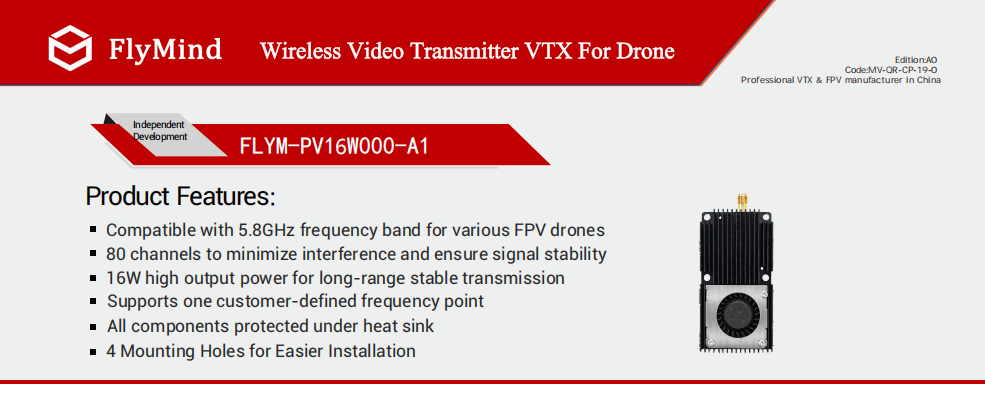
The 16W high-power analog VTX is optimized for partially obstructed environments with greatly improved signal penetration. It can work through light woods, low buildings and minor hills. Its transmission range is nearly 50% longer than the 10W version. It fits suburban terrain survey, short-range mountain inspection and urban periphery pipeline monitoring. It is a mid-to-high end model balancing coverage and equipment stability. Ensure proper ventilation during operation to avoid heat accumulation.
3.5 25W 5.8G Analog VTX: Long-Range Industrial Flagship
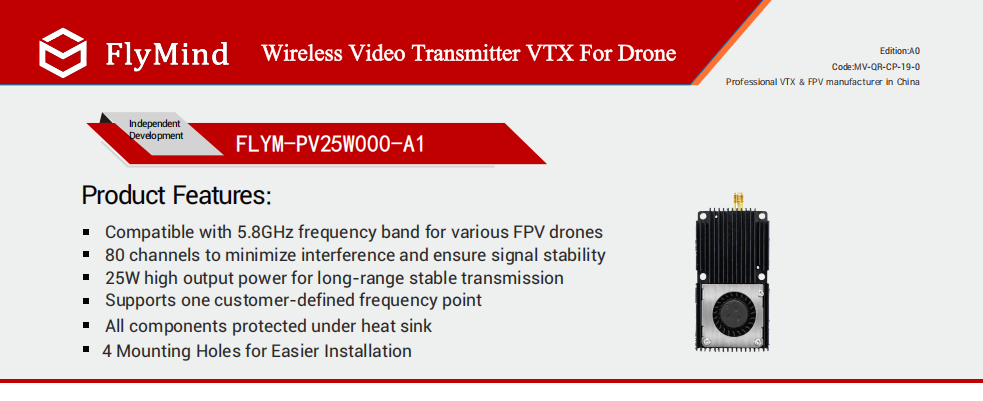
As our top-tier industrial analog VTX, the 25W model delivers ultra-long transmission range and strong anti-obstruction performance for long-endurance missions in mountainous and woodland areas. Its RF design is optimized for complex field electromagnetic environments to resist external interference and maintain stable beyond-line-of-sight video feed. Mainly deployed on large industrial UAVs, long-endurance fixed-wing drones for mountain search & rescue, long-distance power line inspection and field exploration. For safe operation, forced heat dissipation and channel planning are mandatory to prevent thermal shutdown and co-frequency interference.
4. Key Differences Between 5.8GHz and 7.2GHz Frequency Bands
Our 10W/16W/25W industrial analog VTX support dual frequency band options to adapt to different electromagnetic environments. Low-power 2.5W/5W models come with standard 5.8GHz for general use cases:
- 5.8GHz Standard Band
Pros: Wide selection of accessories, high compatibility with antennas and receivers, low commissioning difficulty and controllable cost. It is the industry standard frequency band. Cons: Crowded with WiFi and other wireless devices in cities, prone to image noise in dense urban RF environments. Application: Suburbs, open fields, farmlands, mountainous areas and other locations without heavy signal interference. - 7.2GHz Custom Anti-Interference Band
Pros: Rarely occupied by consumer electronics. Excellent anti-interference performance in cities with low RF noise and clean video feed. No frequency conflict for multi-drone formation flight. Cons: Fewer accessory options and higher precision requirements for antenna installation. Application: Urban building inspection, urban pipeline monitoring, high-density electromagnetic environments and multi-UAV collaborative projects.
5. General Installation & Commissioning Guidelines for All Analog VTX
Around 80% of analog VTX failures are caused by improper thermal design, antenna arrangement, power supply and channel configuration. Standardized commissioning greatly improves equipment reliability:
- Thermal management: Passive cooling is sufficient for 2.5W/5W low-power models. Keep ventilation for 10W units. Enclosed installation is forbidden for 16W/25W high-power transmitters. Air ducts or heat sinks must be fitted to avoid overheating shutdown and signal cut-off.
- Antenna layout: Maintain line-of-sight path between transmitting and receiving antennas. Keep antennas away from flight controllers, ESCs and power supplies which generate strong interference. Use identical antenna polarization for multi-drone operations to minimize signal loss.
- Channel planning: Offset frequency channels in advance for multi-drone formation flights. High-power models are recommended to adopt 80CH version to avoid co-frequency interference and cross-image crosstalk.
- Regulated power supply: Use independent regulated power supply to prevent image jitter and noise caused by voltage fluctuation and ensure stable long-term transmission.
6. Quick Troubleshooting for Common Failures
- Heavy snow noise on screen: Switch to 7.2GHz anti-interference band for urban missions. Check loose antenna connectors and whether antennas are placed close to interference sources.
- Fast signal attenuation behind obstacles: Replace low-power models with 5W/10W mid-power units. Optimize antenna angle for high-power transmitters to boost signal penetration.
- Signal disconnect after continuous operation: Insufficient heat dissipation for high-power VTX. Optimize ventilation structure and add heat sink to prevent overheating protection.
- Mutual interference during multi-drone flight: Re-plan channel frequencies and widen channel gaps to avoid overlapping operation on the same band.
7. Selection Summary
- Ultra-lightweight, indoor short-range and FPV racing scenarios: Prefer 2.5W 5.8G Analog VTX
- Small drone, park / farm routine short-range missions: 5W 5.8G Analog VTX recommended
- Suburban inspection, general industrial mapping and standard projects: 10W 5.8G Analog VTX as standard
- Mild obstructions, medium-range field missions: Select 16W 5.8G Analog VTX
- Long-range mountain missions, heavy obstructions, long-endurance industrial operations: Flagship 25W 5.8G Analog VTX
- Complex urban electromagnetic environment: Prioritize 7.2GHz anti-interference band solution
FlyMind industrial analog VTX covers full power range from 2.5W, 5W, 10W, 16W to 25W. We support band modification, power trimming, interface adaptation, structural customization and other OEM/ODM customization services. We provide one-stop solutions including sample testing, bulk supply and full technical commissioning to meet FPV video transmission demands for all types of industrial drones.
FAQ
Q1: What is the practical difference between 2.5W and 5W analog VTX?
A: The main differences lie in transmission range and anti-interference capability. The 2.5W model is built for ultra-lightweight use and only works for obstacle-free missions within 3km. The 5W version doubles the range with better stability, making it the preferred cost-effective option for small industrial drones.
Q2: What industrial advantages do FlyMind analog VTX have over competitors?
A: We independently develop and manufacture the hardware. Compared with generic market modules, our VTX delivers lower noise floor, less heat generation, stable power output and stronger anti-interference. We also support deep customization, engineering tuning and project adaptation for long-term industrial integration.
Q3: Is a heat sink mandatory for high-power VTX?
A: 2.5W/5W/10W units do not require mandatory heat sinks. A simple heat sink is recommended for 16W models. The 25W high-power transmitter must adopt forced cooling. Without proper thermal design, overheating protection will trigger and cut off video signal during long runtime.
Q4: Analog vs digital VTX: how to choose?
A: Choose analog FPV VTX if you need ultra-low latency, graceful signal degradation, low cost and lightweight hardware. Select digital video transmitters if you prioritize ultra-high image quality and superior long-range anti-interference performance. You may also combine both solutions.
Q5: Can industrial analog VTX be customized for bulk orders?
A: Yes. Our full lineup of 2.5W–25W analog VTX supports OEM/ODM customization, including band tuning, fixed channel configuration, power calibration, interface definition, mechanical housing and logo printing. It can be fully matched to your standard UAV system for mass industrial integration projects.


